

Are keywords still important? The problem with us SEO’s is that we over complicate things. I often get frustrated when I read a businesses latest blog post to try and inform and build trust with potential clients only to find it a showcase of their latest tool and over-use of terminology related to search engine optimisation, no-one but people in the industry will understand.
So, this blog post is about keeping it simple. It’s about giving you a strategy that I have found that you can action now and get clear results. It’s been two years in the making and best of all you won’t have to go through the painstaking process of trying to figure out what will work and what won’t as I have done all this for you!
So, what is this new strategy? It’s all about the way Google has adapted and changed as we have adapted and changed the way we search. Search engines have evolved to prioritize user behavior and relevance. Our home devices, machine learning and AI means that Google needs to act like a human and show results on their pages when someone does a search that matches human behaviour.
The Good Old Days Of SEO

SEO used to be about a straightforward strategy. The bits we did to your website (called on-page optimisation) have rarely changed for the last 13 years I have been doing this. You figure out what words you want to rank for, mention them around 2-3% of the overall text, focusing heavily on keyword density, make sure you have at least 300 words of content and that was it. Keyword stuffing was a common practice to manipulate search engine rankings by overusing specific keywords, often leading to poor content quality. You would then concentrate on getting mentions from other websites (a process called off-page optimisation) and hey presto! Three months you could probably rank for any keyword (my two big successes were ranking for the word “grand national” on the day of the Grand National and ranking for the word “broadband providers” even beating the biggest ISP’s).
And now….? The Role of Search Engines Today
And now….?
I noticed a change in this over the last two years. I was working on quite a competitive niche, the quick house sale industry. After about 4 months, we had stagnated after some great progress and I was quickly running out of ideas and patience. Simply mentioning the main phrases 2-3% no longer was a metric you could live by. Understanding search intent has become crucial for SEO, as it helps in aligning content with the underlying reasons behind users’ search queries. Identifying relevant keywords that align with user search intent is essential for optimizing web pages and improving search engine rankings. Some competitors mentioned 6% and some hardly mentioned it at all and yet consistently ranked high. Then I happened to come across something written by an Industry blog SEMRushcalled How to Win at Local SEO (7 Killer Steps) – SEMrush. In this blog (see I told you I had done the hard work for you) it mentioned how they had found a strategy to get top results in Google for local areas (an area the quick house sale client was trying to dominate) by mentioning other related words not just the word you were trying to rank for, a process called latent semantic indexing (LSI).
An Aha Moment
By mentioning other related words like best, expert, and more emotive terms, and by using long tail keywords, you increased the likelihood of someone clicking on your pages. Effectively targeting keywords is also crucial to improve SEO results, as it ensures that the chosen keywords align with your brand’s content and audience. It also mentioned looking at other related phrases away from the main phrase. See the above blog post for more detail. I carried out the strategy to the letter and saw instant results! I was shocked! I then rolled this out to other clients and saw the same sort of movement.
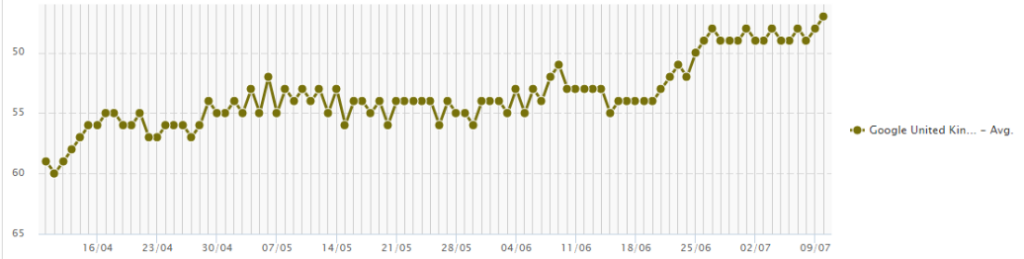
A graph showing ranking increases for the quick house sale company. We quickly gained the top 3 spots in Google for a wide range of local keywords and conversion increased around 30%.
Forward To Present Day
Around December last year, Google released an algorithm change, that caused some of my clients to see a bit of a dip in their current rankings in Google. Luckily, this was near the end of December and so their traffic and conversion didn’t see any major dips. The first week In January I decided to finally get to the bottom of this and develop a robust SEO strategy that would tick all of Google’s boxes, regardless of the algorithm change. Monitoring search trends is also crucial to stay aligned with changing audience interests and enhance conversion potential.
I realised it had to be down to content and about this time, I was heavily researching Google’s new process called Natural Language Programming (NLP). This is Google’s attempt to produce results when someone searches that match user behaviour, without relying on other bits that make up Google’s algorithm like link building and the number of times you mention a word in the text, etc.
I needed to find a way to look at what other competitors were doing, what other words were they mentioning. After playing around with several tools, I found one that allowed me to see exactly what other words I should be mentioning. I implemented the words where they made sense, and as you can see below, In around a month, we saw steady growth in rankings

A Practical Study
So, in terms of applying this to your websites, where do you start?
Well, first you need to consider the main phrase you want to rank for, in my case “SEO Sheffield”. I then use an SEO tool called SEMrush (paid tool) to figure out other related phrases they are using (avoiding stop words like “of”, “and” “at” etc.). Understanding keyword search volume can inform keyword selection by showing the popularity of search terms. Additionally, considering search volume is crucial when choosing keywords to target, as it helps balance popularity against competition to find effective keyword opportunities.
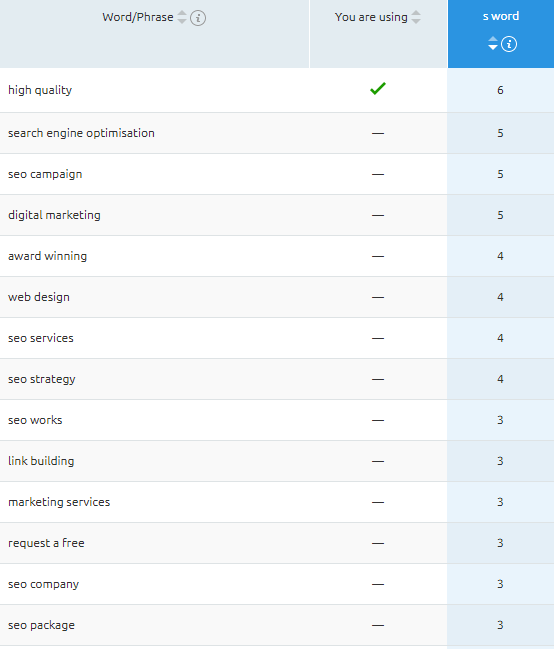
Here we see the top words other competitors are using and the number of sites in the top ten of Google that use these. I need to mention “high quality” 6 of the top ten competitors mention this, “search engine optimisation” obviously, “award-winning” yep as a multi-award winning company, I can mention this and “link building”.
You see by mentioning related words you are giving Google a stronger signal on what “topic” your site should be found for. This is why I said traditional keyword research and on-page optimisation is dead.
As this quite a lengthy blog post, I have decided to split this into two sections and next week I will be telling you about a tool you can use to semi-automate the entire process and best of all it’s completely FREE of charge! I will also share two more cases studies and how this strategy has propelled their conversion and rankings in Google.
Happy Optimising!


