

In an increasingly digital marketplace, even service-based professions like accounting rely heavily on online visibility. While a global reach might seem appealing, the reality for most accounting firms is that their most valuable prospective clients are right in their local area. This is where local search engine optimisation (SEO) becomes not just a tool, but a necessity. If your accounting firm isn’t appearing in local search results, you are missing out on a significant number of potential clients who are actively looking for your services. This guide will walk you through exactly how to optimise your accounting website for local searches, ensuring you connect with the customers who matter most.
We will explore actionable local SEO strategies, from refining your website content to mastering technical SEO elements. Understanding how search engines like Google rank local businesses is the first step towards building a robust online presence that drives real growth for your accounting business.
Why is Local SEO Crucial for Accounting Firms?
Did you know that an estimated 46% of all Google searches have local intent? This means nearly half of the internet users on the world’s largest search engine are looking for products, services, or information within their geographical area. For accounting firms, this statistic is a goldmine. Your target audience isn’t just looking for an accountant; they are looking for an accountant near them. This is why mastering SEO for accountants is fundamentally tied to mastering local SEO.
When potential clients search for terms like “accountant in Manchester” or “tax advisor near me,” search engines prioritise showing them the most relevant local businesses. If your accounting website is not optimised for these queries, you are essentially invisible to a huge portion of your market. A strong local SEO strategy ensures that when these high-intent searches happen, your firm appears prominently in the search engine results pages (SERPs). This visibility translates directly into more website traffic, more qualified leads, and ultimately, more clients for your practice. Effective local SEO builds trust and authority within your local community, positioning your accounting firm as the go-to expert.

How to Optimise for Local Search: The Foundations
Optimising your accounting website begins with a solid foundation. This involves understanding your audience, conducting thorough keyword research, and implementing on-page SEO best practices. These initial local SEO efforts are critical for signalling to search engines where you are and what you do.
Keyword Research for Local Intent
The cornerstone of any successful SEO campaign is keyword research. For local SEO, the focus shifts to local keywords. These are search terms that specify a location. Your goal is to identify the phrases your potential clients are using. Think beyond just “accountant.” They might be searching for specific accounting services like “small business bookkeeping in London” or “self-assessment tax returns in Birmingham.”
Use tools to conduct keyword research and discover what your target audience is searching for. Look for terms with a good balance of search volume and relevance. Once you have a list of relevant keywords, you can begin to integrate them naturally into your website content. This helps search engines understand the services you offer and the areas you serve, which is fundamental to improving your search engine ranking.
On-Page SEO for Local Targeting
On-page SEO involves optimising the individual web pages of your accounting website to rank higher and earn more relevant traffic. For local businesses, this means making your location clear. Here are key on-page elements to focus on:
- Title Tags and Meta Descriptions: Your page titles and meta descriptions are often the first things a user sees in the search results. Include your primary local keyword and city in your title tags. Your meta descriptions should be compelling, encouraging clicks, and should also contain your location and services.
- Header Tags (H1, H2, H3): Structure your content with clear headings. Your main heading (H1) should always include your primary keyword. Use subheadings (H2, H3) to break down content and incorporate other relevant keywords related to your accounting services.
- Website Content: Your website’s copy is paramount. Weave your local keywords and service-related terms throughout your homepage, service pages, and blog posts. Crucially, your name, address, and phone number (NAP) should be consistent and clearly visible, often in the footer of every page. This consistency helps search engines verify your business information.
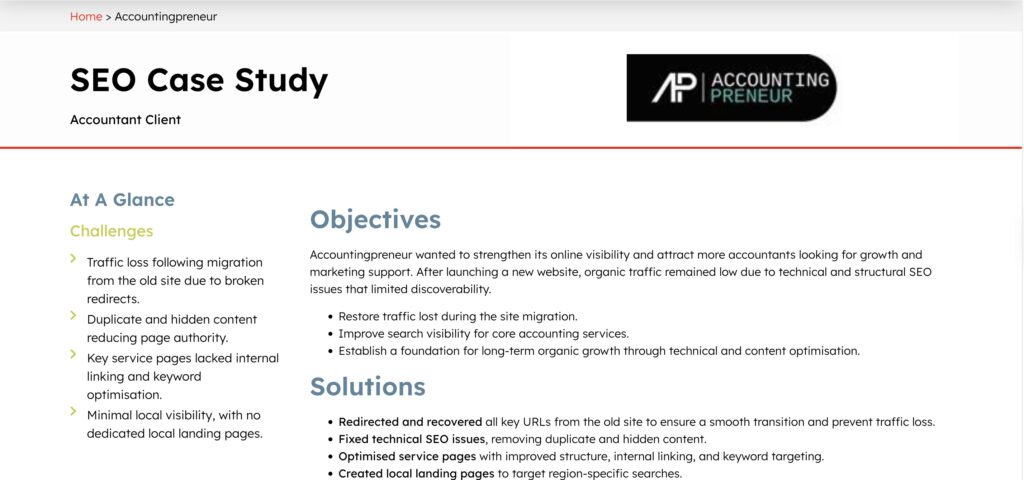
read our latest SEO case study for an accountant client
Google Business Profile and Local Citations
Beyond your own accounting website, your presence across the web plays a huge role in local SEO. Your Google Business Profile (formerly Google My Business) is arguably the most powerful tool in your local SEO arsenal.
Optimising Your Google Business Profile
Your Google Business Profile is a free listing that allows you to appear in Google Search and on Google Maps. When a user performs a local search for an accounting firm, Google often displays a “Local Pack” map with three top businesses. Getting into this prime real estate can dramatically increase calls and enquiries.
To optimise your Google Business Profile:
- Claim and Verify Your Listing: Ensure you have full control over your profile.
- Complete Every Section: Fill out all available information, including your business name, address, phone number, hours, and website.
- Choose the Right Categories: Select “Accountant” as your primary category and add secondary categories for specific accounting services you offer (e.g., “Tax Consultant,” “Bookkeeping Service”).
- Upload High-Quality Photos: Show off your office, your team, and even your logo to make your profile more engaging.
- Encourage Online Reviews: Positive reviews are a significant search engine ranking factor. Ask satisfied clients to leave a review.
- Use Google Posts: Regularly share updates, offers, and articles through Google Posts to keep your profile active and engaging.
The Power of Local Citations and Directories
Local citations are mentions of your accounting firm’s name, address, and phone number on other websites. These can be found in online directories like Yelp, Thomson Local, and industry-specific business directories. Consistent citations across various reputable online directories reinforce the validity of your business information for search engines.
Ensure your NAP is 100% consistent across all directory listings. Inconsistencies can confuse search engines and harm your local search rankings. Building a strong portfolio of local citations from high-quality sources is a key component of an effective local SEO strategy. These local listings signal to search engines that your accounting business is legitimate and established in its community.
Creating Local Landing Pages and Content
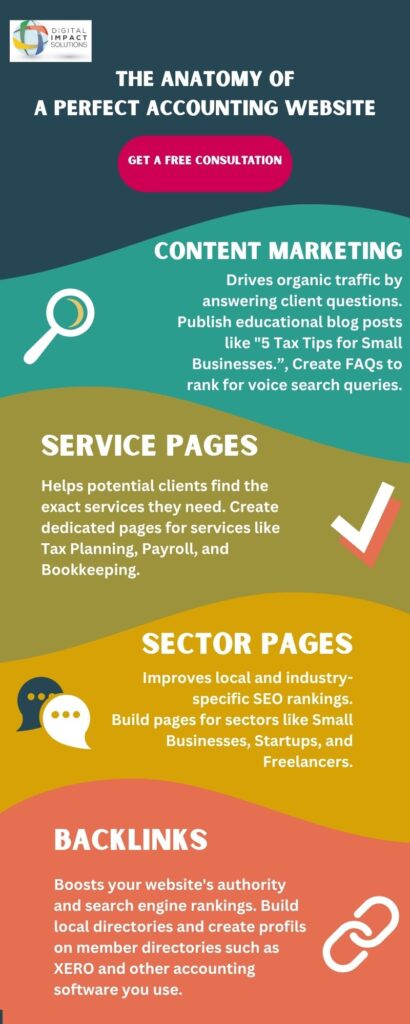 For accounting firms serving multiple towns or areas, local landing pages can be a game-changer. These are web pages created specifically to target a particular geographical area. For example, if your firm is based in Leeds but also serves clients in Bradford and Wakefield, you could create a dedicated service page for each city.
Each landing page should feature unique, high-quality content tailored to that specific location. Discuss local issues relevant to businesses in that area, mention local landmarks, and include testimonials from clients in that city. This strategy helps search engines understand that you are a relevant provider for people in those specific locations, improving your chances of appearing in local search results for each one. This is a powerful way to expand your reach without needing a physical office in every town.
Your broader website content strategy should also have a local focus. Writing blog posts about local tax regulations, financial tips for small businesses in your region, or sponsoring a local community event can generate valuable local backlinks and demonstrate your firm’s commitment to the area. This approach creates high-quality content that attracts your target audience and strengthens your accounting firm’s website authority.
Leveraging Local Events and Blog Posts
Engaging with your local community offline can have powerful online benefits. Sponsoring a local charity event, hosting a free financial workshop for local businesses, or speaking at a local business conference are excellent ways to build brand awareness.
When you participate in these events, write about them. Create a blog post summarising the event, share photos on your social media and Google Business Profile, and mention any other local businesses or organisations that were involved. This activity creates fresh, locally-relevant content for your accounting website and often results in backlinks from other websites (like the event organiser or local news outlets), which are invaluable for SEO. These local SEO efforts show search engines that you are an active and authoritative member of your community.
Technical SEO and Essential Tools
A well-optimised website also needs to be technically sound. Technical SEO refers to the optimisations that help search engines crawl and index your site more effectively.
- Mobile Optimisation: A significant portion of local searches happen on mobile devices. Your accounting website must be mobile-friendly. A responsive design that adapts to all screen sizes is no longer optional; it is essential for a good user experience and for your search engine ranking. Mobile optimisation is a critical ranking factor.
- Site Speed: Users expect pages to load quickly. A slow website leads to a poor user experience and can negatively impact your search rankings. Use tools to test and improve your site speed.
- Site Structure: A logical site structure makes it easy for both users and search engines to navigate your accounting firm’s website. Ensure your service pages are easy to find from your main menu.
Using Google Search Console and Google Analytics
To measure and refine your local SEO strategies, you need data. Google provides two powerful, free tools for this:
- Google Search Console: This tool helps you monitor your website’s performance in Google search results. You can see which keywords are driving traffic, identify technical issues like crawl errors, and submit sitemaps to help search engines understand your site structure. If your accounting website receives a good amount of traffic, take time to review historical clicks and impressions for each page. This can help uncover opportunities for improvement—especially for pages that are gaining traction but aren’t quite reaching page one in the search engine results pages. Using a ranking tool, check average positions to spot any keywords or pages currently ranking on page 2; with some targeted optimisation, these could be pushed to page 1 for significant gains in visibility and website traffic. Additionally, regularly review the “Coverage” and “Index” reports in Search Console to ensure Google is indexing the most important pages on your site, not old or thin content, to maximise your online visibility and prevent valuable accounting services from being overlooked. Google Search Console is indispensable for any serious digital marketing strategy. Google Search Console is indispensable for any serious digital marketing strategy.
- Google Analytics: This platform provides detailed insights into your website traffic. You can see how many visitors you’re getting, where they’re coming from (e.g., organic search, social media), what pages they visit, and how long they stay. By using Google Analytics, accounting firms can understand user behaviour and make data-driven decisions to improve their SEO efforts and overall website performance.
The Future of Local SEO for Accounting Firms
The digital marketing landscape is always changing, and local SEO is no exception. The rise of voice search (“Hey Google, find an accountant near me”) and AI-driven search results means that search intent and user experience are more important than ever. Search engines are getting better at understanding the context behind a search and delivering the most relevant, direct answers.
For accounting firms, this means the core principles of good SEO will become even more critical. Creating high-quality, authoritative content that directly answers the questions of prospective clients is key. Building a strong reputation through online reviews and local engagement will continue to be a deciding factor.
Ultimately, the goal of local SEO is to make it as easy as possible for local clients to find and choose your accounting firm. By implementing the SEO strategies outlined in this guide—from optimising your Google Business Profile to creating locally-focused content and ensuring your technical SEO is solid—you can significantly improve your online visibility. A well-optimised website is your most powerful tool for attracting more clients and growing your accounting practice in the digital age. Don’t let your competitors dominate the local search engine results pages; start implementing these local SEO tactics today. If the process seems overwhelming, consider partnering with a specialised SEO company or SEO agency to help your firm navigate the complexities and achieve a top search engine ranking.


