
The reliability of a keyword research tool depends on its data sources, but it is not an as simple question to answer in one line. Therefore, we need to understand the complex algorithms and working techniques of keyword research tools before discussing the reliability of any SEO keyword research tool, like SEMrush.
Keyword research tool function
Keyword research tools are specially designed software that provide an up-to-time insight into search engines. SEO experts use keyword research tools to find the terms or phrases used by their targeted audience to find specific niche services or products.
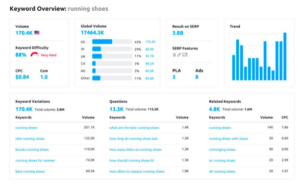
Keyword research tools provide in detail data of keywords such as:
- Keyword search volume in the targeted location
- Keyword search volume globally
- Keyword variations
- Related Keywords
- Keywords embedded questions
- Active and past Google Ads on that keyword
- Keyword difficulty
- CPC, it’s helpful if you’re planning to run Google Ad on that keyword.
- Search engine result page analysis (SERP)
Let’s have a look at the plethora of information displayed by SEMrush when we search a keyword ‘running shoes’.
Some of the top-notch keywords research tools are listed below,
Various keywords research tools may have different additional SEO features and algorithms. Let’s take SEMrush as an example to discuss its data sourcing techniques to know the reliability level of a keyword research tool.
SEMrush |Keywords and Competitors Research
SEMrush is not just a keyword searching software but a complete SEO tool. SEO experts, content writers and digital markets use this tool to get maximum organic traffic and increase conversion rates. SEMrush is equally beneficial in both organic and paid marketing.
Some of the significant features of SEMrush are:
- Keywords search volume | Domain ranking
- Monthly Web Traffic
- Backlink’s data
- Ad’s data
- Social media data
We will discuss each of the above-listed features to learn how these features work and how such tools get enough data to share a treasure of authenticated information.
Keywords Search Volume | Domain Ranking
SEMrush has more than 16.4 billion keywords in its database. While searching a keyword shows the plethora of related keywords, question keywords, competitors-focused keywords, domains, sub-domains, URL data and much more information in the report.
In addition, it enables you to compare multiple domain-ranked keywords. For example, it lets you choose product listing adds keywords, organic keywords, or paid keywords to set comparisons among the various sites. Such in-depth insights help you find unique opportunities to perform better than your competitors to get rank.
Data Sourcing
SEMrush and other keyword searching tools usually use third-party data sourcing software to get Google and other top-rated search engines’ insight. After getting data for millions of websites, SEMrush focuses on the top 100 sites against a keyword for in-detail analysis of its paid and organic traffic.
These well-researched keywords and domains data are compared and analysed by SEMrush to get live data for its users. SEMrush updates its database every month to provide up-to-minute search engine insights to its users.
Monthly Web Traffic
SEMrush incredible traffic analytics lets its user get monthly estimated traffic on any domain. For that, SEMrush traffic analytics takes data of 500+ million genuine internet users throughout the globe.
SEMrush has hundreds of clickstream data providing partners on their panel. These partners are responsible for sharing data of nearly 2 billion click events daily by preserving users’ privacy.
After collecting data from multiple sources, SEMrush’s cutting-edge Neural network compares data from all sources to present refined and most trusted data before its users. Comparing data from various sources enables SEMrush to understand the internet user’s behaviour to a group of keywords. Eventually, it allows us to set an intent-based keyword research strategy.
Backlinks Data
Backlinks are one of the vital off-page SEO elements. SEMrush intelligent algorithm provides in-detail info on all backlinks of a domain. You can enter your own or your competitor’s domain to get detailed backlinks reports. Such detailed back-linking reports aid SEO experts in finding black holes or new opportunities to increase your site’s visibility.
SEMrush database has trillions of backlinks information and the database is continuously growing as SEMrush Backlink Crawler inspects nearly 17 billion web pages daily to update its backlinks database.
Ads Data
Google Ads is a vital marketing technique to boost any business conversion rates. But digital marketers struggle to find perfect intent-based keywords to target their niche audience.
SEMrush lets you access its inclusive database of over 1 billion ads run on Google platforms. By looking at your competitor’s ads and the results of certain ads, you can find the ideal keywords and audience behaviour to different elements to run a successful campaign.
How SEMrush Gets Ads Data?
While analysing search engine results, SEMrush records the Google Ads (PPC campaigns) and Google shopping Ads (PLA campaigns) into its database.
SEMrush trusted partners provide display ads (Graphic ads) data to store in a database. This incredible data helps you to stay a step ahead of your competitors by designing ads on market-tested keywords.
Social Media Data
SEMrush records social media platforms like Facebook, Twitter, Instagram, Pinterest and YouTube engagements without breaching user’s privacy.
SEMrush use public APIs of SM networks to record the data by ensuring user’s privacy. Likes, comments, shares, retweets, video views, and hashtags of your chosen page are tracked to represent a well-organised report.
SEMrush collects the personal data of its users in a specific case when its users use SEMrush social media posters to automate content calendar or view business page analytics.
Conclusion
We have discussed nearly all the data sourcing algorithms and techniques of SEMrush. Most of the time, SEMrush collects data via third-party partner tools. It feels logical as a single firm or algorithm can’t collect data from crawling millions of web pages daily.
The multiple data sourcing techniques make SEMrush a pretty reliable keyword researching tool. However, in the end, the reliability of any keyword researching tool depends on its data sourcing partners, updating intervals, and algorithm smartness.


